Though the healthcare sector has been slow to adopt technological advancements, it is currently experiencing an unparalleled digital transformation. With the sudden growth in telemedicine post-COVID, reliance on EHR, and AI-based diagnostics, the need for agile, scalable, and compliant software solutions has become a much-needed imperative for healthcare organizations. This is where, DevOps started becoming a part of healthcare organizations like hospitals, clinics, pharmaceutical companies, and health tech startups. It has accelerated the innovation process and brought new solutions to market more quickly.
What DevOps brought to the table for healthcare organizations was that it aligned with the growing number of regulatory regimes, maintained compliance efficiently, prepared for audits, and simplified operations. In this blog, we at XByte as the leading DevOps consulting services, explain how having DevOps as a part of the healthcare ecosystem has resulted in healthcare innovation, improved security, and compliance postures at scale, along with patient safety.DevOps: The Catalyst for Change in Healthcare
Healthcare organizations were late entrants to the world of digital transformation. The initial reluctance was soon transformed into a plethora of digital transformation initiatives that soon took a huge shape. Providers, Payers, and Life sciences that used technology to improve patient care, had to soon come to terms with a huge bottleneck— compliance. As healthcare data grew so did the need to tackle the complexities associated with it. Top management consulting firm McKinsey highlights this in their report where they point out that risk concerns and considerations were among healthcare leaders’ top challenges when scaling up technological solutions.
This is when DevOps came up with a solution that could eliminate the complexities that disparate systems and practices brought.
Challenges Faced By Healthcare Before Incorporating DevOps
The traditional healthcare systems relied hugely on manual processes for software development, deployment, and infrastructure management, which was a recipe for delays and inefficiencies. The greatest hassle for healthcare was the miscommunication and delays that emanated as the development, operations, and quality assurance teams continued to work in silos.
Additionally, the slow pace at which bugs and system failures were identified created newer challenges besides the existing ones, often delaying healthcare product rollouts and updates. And with the manual process of managing infrastructure configuration errors were a norm.
The complex and vast expanse of healthcare made scaling applications a labor-intensive process and required meticulous levels of planning and resources.
The biggest challenge among these was the separate and time-consuming steps needed to meet healthcare regulations such as HIPAA or GDPR. But with DevOp, all this was up for a drastic change.
A report from Gartner highlights that as a way to tackle these challenges, organizations have increasingly started adopting DevOps.
Implement cloud system into your healthcare organization to streamline the routine processes!
Reimagining Healthcare Practices with DevOps
DevOps at its core brings with it the potential to bridge the gap between the software development and IT operations across industries, and healthcare is no different. For healthcare, DevOps brings the additional capability of adhering to non-negotiable regulatory demands.
With the onset of the DevOps framework, healthcare organizations started seeing a marked change where complex healthcare systems that grappled with silos were transformed into collaborative, agile environments. With DevOps, healthcare giants began to soon see an improvement in patient care, and quality, and enabled continuous delivery of updates and improvements, all while reducing inefficiencies and enhancing organizational agility in healthcare settings.
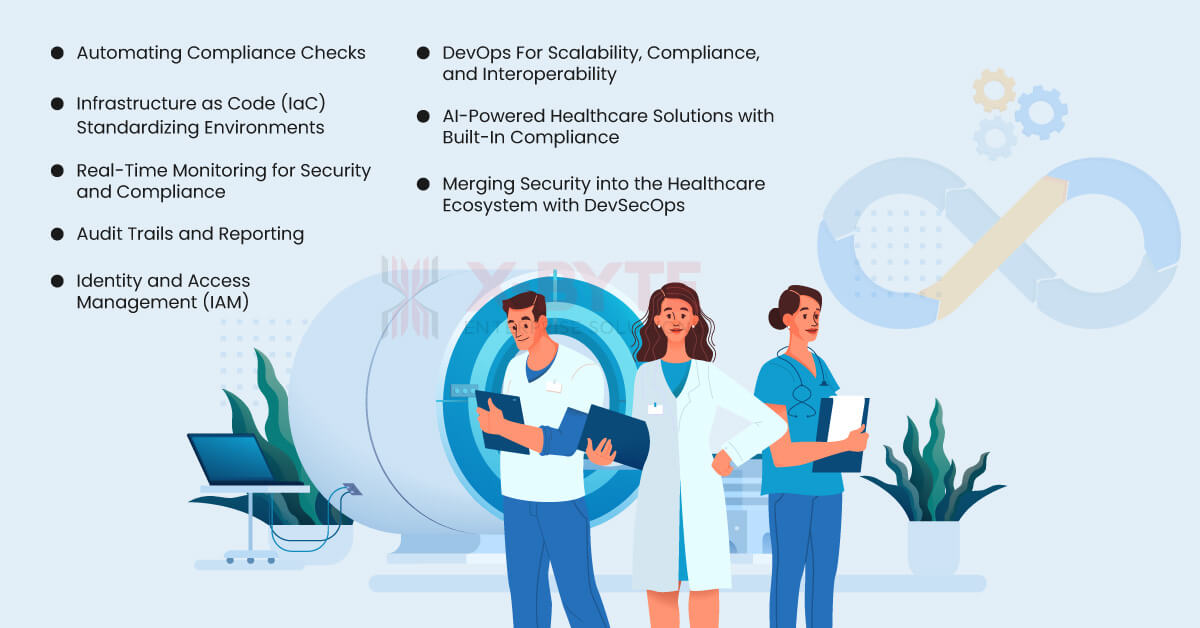
Automating Compliance Checks
The beauty of the DevOps framework lies in the CI/CD pipelines that automate software deployment. With the DevOps framework being a part of the core ecosystem, healthcare applications began to be rolled out faster, and the time-to-market for life-saving technologies reduced enormously.
Another stand-out capability that came with incorporating DevOps practices was the policy-as-code that allowed automated validation of security policies and regulatory requirements. The advantage? Reduced human error and audit risks.
Infrastructure as Code (IaC) Standardizing Environments
IaC is a core pillar of DevOps and enables the configuration and management of healthcare IT infrastructure using code. This stood as a failsafe way to ensure consistency across development, testing, and production environments and mitigated compliance risks by eliminating configuration drift and ensuring adherence to predefined security protocols.
The use of Infrastructure as Code (IaC) within healthcare IT is increasing due to the demand for scalable and efficient infrastructure management. Recent market analyses suggest that the global Infrastructure as Code sector will reach approximately USD 5869.3 million by 2032, with a compound annual growth rate of 3.52% from 2024 to 2032. This expansion is particularly evident in the healthcare industry, where IaC tools are essential for handling intricate and compliance-sensitive systems.
Real-Time Monitoring for Security and Compliance
Audit Trails and Reporting
Healthcare use cases are critical and the data generated is vast. When healthcare organizations started with DevOps, detailed logs and automated audit trails were generated, further simplifying regulatory reporting.
In 2024, the healthcare sector witnessed a 9% increase in the total number of patient records exposed, rising from 168 million to 183 million. This alarming statistic highlights the critical need for comprehensive audit trails and reporting in healthcare IT infrastructure.
DevOps For Scalability, Compliance, and Interoperability
AI-Powered Healthcare Solutions with Built-In Compliance
Merging Security into the Healthcare Ecosystem with DevSecOps
Identity and Access Management (IAM)
As a measure of handling critical healthcare data, DevOps tools enforce IAM policies. These ensure that only authorized users can access sensitive healthcare data and the automated role-based access controls (RBAC) improve compliance by restricting data access based on user roles.
Cloud-based IAM offers enhanced features such as Single Sign-On (SSO), Multi-Factor Authentication (MFA), and automated provisioning, which are crucial for improving both security and operational efficiency in healthcare organizations.
At X-Byte, over the years we have helped healthcare organizations globally to achieve faster time-to-market, improved patient outcomes, and regulatory alignment through DevOps services for healthcare. We specialize in providing healthcare software development, telemedicine app development, and doctor-on-demand app development services.
Revolutionize Healthcare with X-Byte’s DevOps expertise!
Key Benefits of DevOps in Healthcare
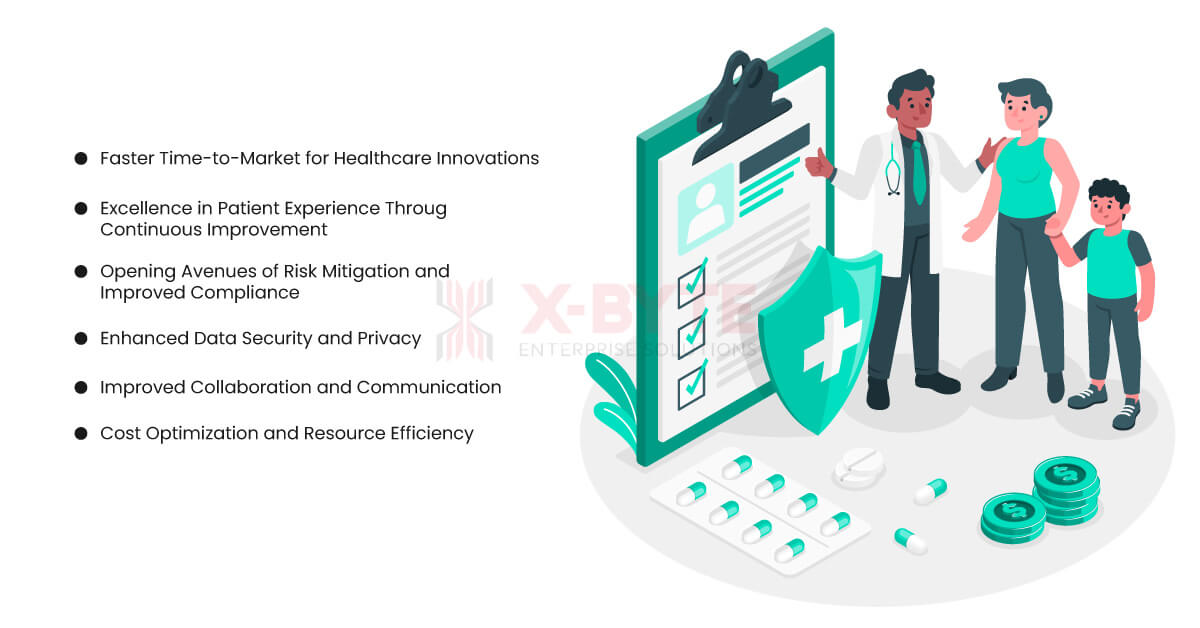
Faster Time-to-Market for Healthcare Innovations
Excellence in Patient Experience Through Continuous Improvement
Opening Avenues of Risk Mitigation and Improved Compliance
Enhanced Data Security and Privacy
DevOps improves healthcare data security through automated testing and monitoring, quickly identifying vulnerabilities. DevSecOps integrates security throughout development, protecting sensitive patient information from the start.
Improved Collaboration and Communication
Cost Optimization and Resource Efficiency
An Innovation-Centric Future of Healthcare Powered by DevOps
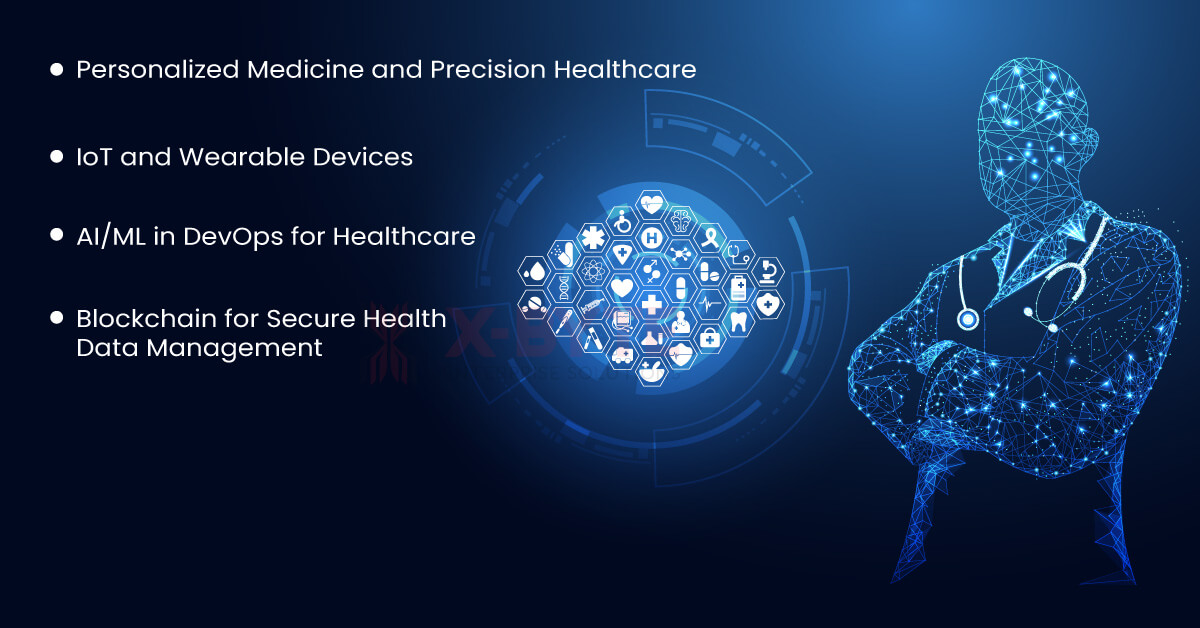
Personalized Medicine and Precision Healthcare
IoT and Wearable Devices
AI/ML in DevOps for Healthcare
Blockchain for Secure Health Data Management
DevOps as a Strategic Imperative for Healthcare
DevOps frameworks have the power to deliver speed without sacrificing compliance. Healthcare is under a lot of pressure to comply with strict regulations such as HIPAA, GDPR, etc., and the growing law enforcement to make healthcare data more secure is a primary concern. With DevOps, these challenges can be solved as it embeds compliance into every stage of the software development lifecycle.
Since DevOps ensures the combination of automation tools, secure coding practices, and rigorous testing, it ensures that compliance isn’t a later consideration but a foundational part of every deployment.
As per Google Clouds’ 2024 DORA Accelerate State of DevOps report–The adoption of DevOps brings a 25% increase in productivity and job satisfaction.
In traditional models where compliance is a separate phase, incorporating DevOps ensures that integrating compliance doesn’t become a separate task, but a part of every step of the development cycle.
DevOps accelerates innovation while embedding compliance into the heart of healthcare technology. If integrating automation, enabling continuous monitoring, and a collaborative culture is your aim for your healthcare organization then DevOps is the way forward.

Discover the full potential of your healthcare solutions with X-Byte’s DevOps expertise!
X-Byte, Driving Innovation in Healthcare with Agile DevOps Solutions
Though the initial phase of adoption eliminated a lot of challenges, the same technology that was incorporated to ease operations and improve patient care, introduced new complexities like slower deployment cycles, siloed teams, manual inefficiencies, and difficulties in maintaining compliance with strict regulations. DevOps changed this with quicker software deployment and faster completion of routine tasks through automation. In the healthcare sector, DevOps initiatives also ensure adherence to compliance standards and maintain strong security measures, allowing organizations to innovate rapidly while safeguarding.
X-Byte is one of the top emerging DevOps consulting companies that has changed the trajectory of operations for healthcare organizations by automating internal engineering processes through the combination of state-of-the-art technologies, healthcare software development, and integrated approaches for healthcare. Our DevOps consulting provides end-to-end solutions that include DevOps automation, management, assessment, strategy and consulting, and DevOps as a cloud platform for healthcare.
Connect with us today to drive efficiency and deliver secure, patient-centric solutions with our DevOps consulting services.