
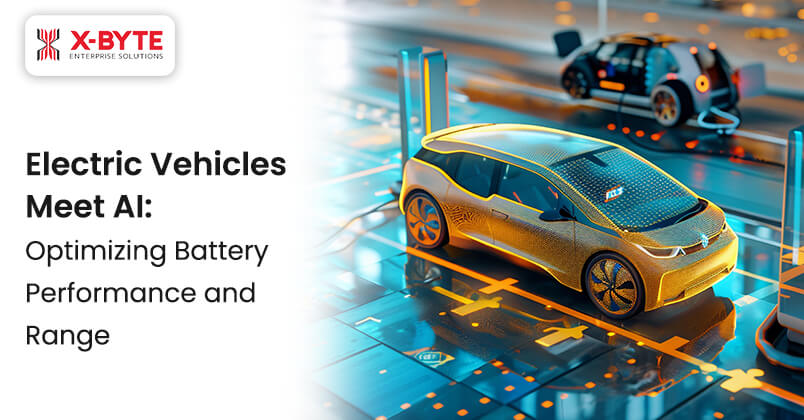
Imagine beginning a journey in your electric vehicle with a continuous anxiety to focus on the remaining distance before you need to recharge. The problem of range anxiety in EVs can be minimized through real-time energy optimization in your vehicle. Researchers have realized that artificial intelligence is an essential solution to optimizing batteries in EVs.
The application of artificial intelligence enables EVs to improve battery performance and extend the driving range. This is done through artificial intelligence development services that develop AI software in a way that makes behavioral analysis, assessments of road conditions, and evaluation of weather data possible. Artificial Intelligence technology, predictive maintenance, and smart energy management systems guarantee persistent power, dependable operations, and continuous performance enhancements for EVs.
This blog demonstrates how AI in EV optimizes battery performance and range, and analyzes the future of AI for EVs.
The Role of AI in Electric Vehicles
Artificial intelligence through its revolutionary applications makes EV battery performance better while also extending vehicle driving ranges. AI technology examines real-time information to improve the systems of battery management. AI predicts power usage and enhances the performance of charging within batteries.
For example, the 2014 Model S P85 of Tesla exceeded 1.24 million miles in distance revealing the long-term durability of electric vehicles (EVs). AI-based analysis of elaborate driving history combined with charging records from this Model S P85 enables the system to optimize battery longevity by reducing operational degradation over time.
Therefore, an AI-enabled smart battery management system with built-in capabilities of controlling charging cycle and managing temperature enables longevity of electric vehicle batteries.
How AI Optimizes EV Battery Performance?
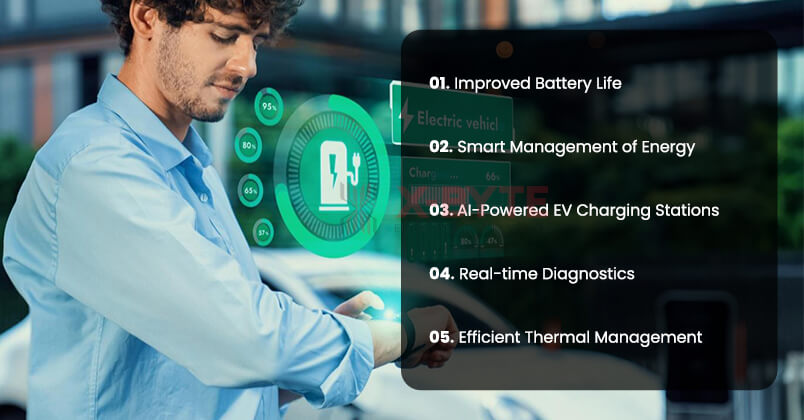
Improved Battery Life
AI system uses continuous cycle assessment to detect patterns that cause early battery failure. Like, Machine learning identifies battery data and maintenance efforts from analyzing previous data and specific wear patterns of each battery. Also, neural networks technology finds non-linear links between the battery and its surrounding environment. This technology analyzes issues in either charging behaviours or rising temperature that is causing damage to the battery lifespan.
That is why the Battery Management System of electric vehicles must be robust. For example, Tesla’s battery management system follows AI guidance to control charging speeds automatically, thus avoiding cell damage through overcharging processes.
Smart Management of Energy
The AI-driven energy management systems assess multiple parameters including battery charge status, driving behavior and external elements (e.g. temperature and road gradient) to achieve optimized power distribution. AI adjusts power output because it optimizes system efficiency and improves battery lifespan. Electric cars powered by AI operate with adaptive energy distribution for efficiency.
According to IBM, the incorporation of AI and machine learning algorithms has the potential to develop energy efficient and sustainable batteries that will help in the prevention of energy waste.
AI-Powered EV Charging Stations
EV market penetration depends heavily on efficient charging systems. AI optimizes charging operations by adjusting power flow and computing ideal charging windows. The AI-powered charging monitors ongoing energy level and predicts battery wear to enhance battery service longevity. AI-powered EV charging incorporates artificial intelligence for the following key functions:
Do you know that through AI, Tesla offers drivers the Trip Planner feature that helps them make efficient route plans alongside charging stop selections to improve their complete journey? Thus, EV technology progresses significantly because of AI technological developments and advancements.
- To distribute power more efficiently through real-time power load management procedures.
- Smart grid applications along with dynamic pricing methods allow the reduction of electricity expenses.
- The system permitting V2G (vehicle-to-grid) data exchange between EVs and the electric power grid to transfer power between vehicles and utilities.
Real-time Diagnostics
Do you know that the AI system is capable of platform tracks of each cell of a battery independently to recognize irregularities. AI-based diagnostic systems prevent battery failures and decrease both production expenses and end-user costs.
Want smart dashboard solutions powering your EVs?
Efficient Thermal Management
The efficiency and operational lifespan of batteries, especially lithium-ion batteries, directly depend on proper temperature maintenance. AI applications for thermal management predict heat levels within battery packs to appropriately distribute heat and guarantee performance improvement as well as overheating prevention.
The implementation of artificial intelligence solutions enables EVs to become better, more dependable, and performance-efficient, which drives mass adoption and sustainability.
Artificial intelligence + Innovative energy storage solutions = The Future of Sustainable Transportation.
| Technology | Description | Key Advantages |
|---|---|---|
| Smart Batteries with AI Integration | Batteries equipped with AI capabilities for optimized energy management |
|
| Thermal Management Systems | Advanced systems to regulate battery temperature |
|
| AI-Powered Battery Management | Continuous monitoring and adjustment of battery usage based on various factors |
|
| Bi-Directional Energy Flow | Batteries capable of both consuming and supplying power to the grid |
|
| Predictive Analytics | Use of AI algorithms to analyze battery health and performance |
|
The above smart battery technologies represent the cutting edge of EV battery development.
Role of AI in Range Optimization
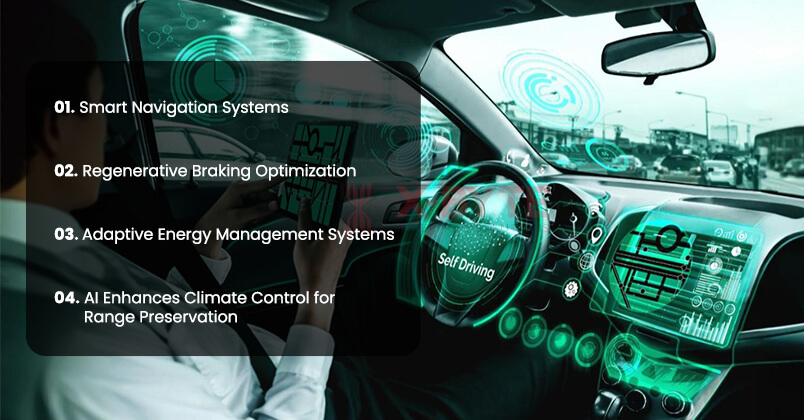
Smart Navigation Systems
Power-efficient routes are identified by navigation systems which use AI algorithms to interpret information about traffic conditions and environmental factors. AI analyzes traffic congestion data to identify different routes so that drivers can optimize their driving routes and remain stress-free. These systems identify elevations and road conditions to prevent drivers from taking paths that use too much energy.
Through its smart route planning system, the technology saves power while making driving less stressful due to restricted distance capabilities. As per the research of the Journal of Transport & Health, driving environment and different routes can affect the well-being (especially emotions and stress levels) of drivers. An AI-powered system shows improved range calculation through monitoring driver behavior and analyzing terrains. This results in a substantial reduction of electrical vehicle driver range worry.
Regenerative Braking Optimization
During braking, EVs can transform their momentum into electricity that their batteries then store. The real-time adjustments of braking mechanisms accomplished through AI result in maximum energy recovery. AI systems analyze driving data, while braking, to predict stops. This enables using regenerative braking to capture maximum energy. This way, the vehicle achieves better energy efficiency and increased distance travel, therefore optimizing range.
Are you aware that enhancements in regenerative braking efficiency with the help of AI may increase the driving range by an additional 10% to 15%. Thus, AI algorithms identify maximum possible recovery of energy through optimal braking force, which results in better vehicle efficiency.
Adaptive Energy Management Systems
The intelligent management of energy (such as battery power, thermal energy, charging energy) allows electric vehicles to reduce unnecessary power use and optimize range efficiency. The improved battery condition due to AI enables EVs to maintain superior performance capabilities.
AI-powered Adaptive Energy Management Systems transform electric vehicles by minimizing energy wastage, optimizing battery operation and improving driving performance efficiency. This makes EVs to travel further distances while becoming more practical for enduring road journeys.
AI Enhances Climate Control for Range Preservation
AI improves the climate control of the battery life in extreme weather conditions by using substantial power. AI technology optimizes EV HVAC systems to decrease power usage and create optimal interior temperatures. AI-based models evaluate temperature together with occupancy data and driver preference data for dynamic control adjustments. Machine learning optimizes energy distribution for better efficiency while it extends driving range with no reduction in comfort.
The advanced thermal management with the help of AI prepares the cabin temperature before driving by using residual charging power. This decreases the energy consumption during operation and extends the vehicle’s range.
Extended Role of AI in EV Mobility
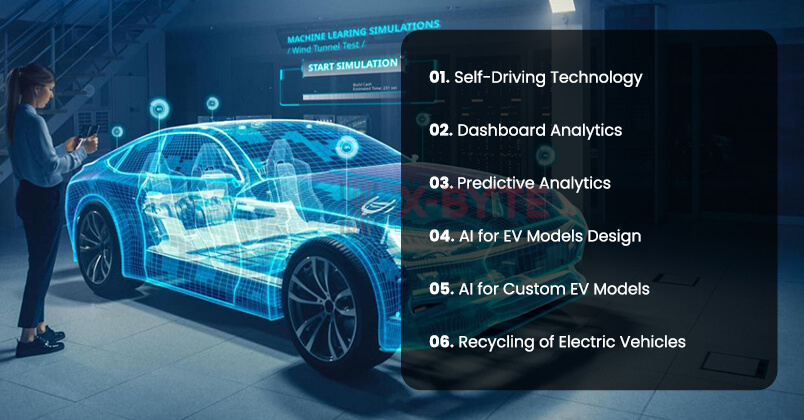
Self-Driving Technology
Self-driving systems powered by artificial intelligence determine accurate driving measures and improve safety. With AI, passengers’ comfort also increases because extensive datasets help in providing time-sensitive decisions.
For instance, the information detectors input the Waymo Driver with all necessary information, including map data and location, by using artificial intelligence, and determine optimal driving actions. The Waymo Driver calculates all safety-related aspects immediately for navigation, including direction, movement, steering commands and speed control for the duration of the trip.
Dashboard Analytics
AI dashboards generate time-sensitive data and provide insights to drivers. These analytics are used to track battery conditions, driving efficiency, energy usage, and predictive maintenance alerts. Machine learning algorithms examine the driving behaviour and road conditions to create customized suggestions that deliver improved driving experiences and extended vehicle lifetime.
Are you ready to take your EV performance to the next level?
Predictive Analytics for EVs
The predictive analytics powered by AI uses algorithms to analyze historical and contemporary data of electric vehicles. The models spot warning patterns by detecting irregularities in engine vibrations, excessive heat levels, fluctuations in battery voltage, etc.
For example, if your EV has some issue in temperature management of the engine. Then AI predictive analytics will detect this issue by predicting cooling system failure that will occur in approximately the next few weeks, thus ensuring timely maintenance.
AI for EV Models Design
AI serves as an essential element during EV model design by improving weight positioning and effectiveness of energy consumption. Machine learning algos develops lightweight designs for EV that maintain durability by analysing large datasets related to the composition of materials and structural integrity.
Paul Roetzer, founder of the Marketing AI Institute and SmarterX, discussed the foundational concepts of AI and its impact on the E-mobility space. He stated that AI simulations forecast safety of EVs, optimization of battery placement, and heat regulation systems to yield vehicles that combine safety and economy with lower production costs. The use of data analysis lets automobile manufacturers create better performing EVs while decreasing production expenses and environmental footprint.
AI for Custom EV Models
AI systems enable manufacturers to create EV models which match specific customer needs, driving patterns and market-specific standards. Design programs powered by artificial intelligence help automakers customize vehicles through controlling battery capacity, motor specifications, as well as planning interior spaces.
With AI’s custom designing feature in EV, customers gain superior satisfaction, and more efficient operations. Through personalized EV solutions, businesses and users make their EVs tailored according to their requirements.
Recycling of Electric Vehicles
The effective management of batteries at their end of life becomes vital for sustainability because they possess dangerous materials like lead, lithium. The proper management of batteries depends heavily on AI-supported recycling processes alongside tracking and tracing systems.
Appropriate battery recycling methods are essential not only for environmental sustainability but also for the ethical responsibility of EV manufacturers. AI helps in the prediction of battery end-of-life, combined with tracking capabilities, and workflow optimization. AI technology maximizes EV battery recycling operations by segregating high levels of materials so that they can be used in other EVs.
Wrapping Up
The incorporation of artificial intelligence with electric vehicles transforms the way we move forward. Artificial Intelligence Development Services enables companies to discover AI-powered solutions that boost EV battery effectiveness and range capabilities. The development of AI technology will expand the electric mobility of EVs to drive innovation and speed up the shift to an environmentally friendly transportation system.
X-Byte Solutions provides businesses with their state-of-the-art Automotive Software Development Services for powering the upcoming generation of electric vehicles. Whether you’re an EV manufacturer or logistics company with truck fleets, X-Byte Solutions can help you extend battery life, and optimize range with AI-powered solutions.