
Overview of Cloud Computing In Healthcare
Types and Models of Cloud Computing in Healthcare
Deployment Models
Service ModelDevOps
Implement cloud system into your healthcare organization to streamline the routine processes!
Benefits of Cloud Computing in Healthcare
According to Gartner, the market for AI-powered wearables is slowly rising and shows a potential to reach 644 million units combined with a spending of $90 billion. However, some major players stand apart for their capabilities and the AI-powered features they provide. Here are the best 5 AI-powered wearables that have scaled the ranks.
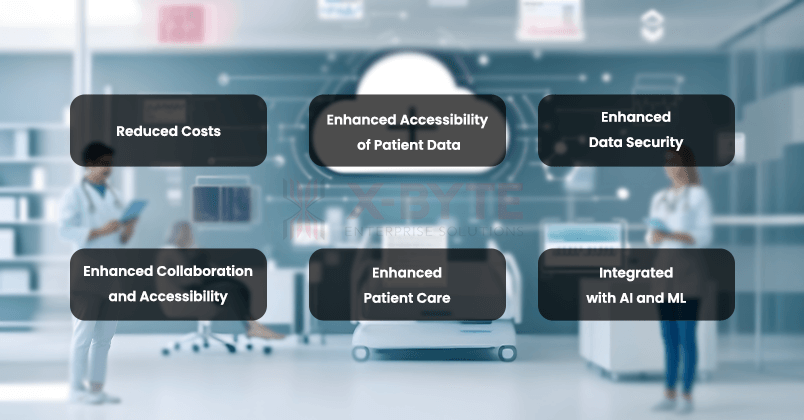
Reduced Costs
Enhanced Accessibility of Patient Data
Enhanced Data Security
Enhanced Collaboration and Accessibility
With cloud data management, hospitals and healthcare organizations can gather patients’ data from various sources to analyze their health situation. It helps in real-time accessibility and provides treatment based on the current scenario.
Enhanced Patient Care
Integrated with AI and ML
Challenges of Cloud Computing in Healthcare

Usually, healthcare organizations face diverse operational and technical challenges when migrating to cloud computing systems. Below are a few challenges of cloud computing in healthcare:
Get enhanced accessibility and boost service quality by migrating to modern cloud solutions!
Future of Cloud Computing in Healthcare
Advanced Analytics and Artificial Intelligence (AI)
Cloud computing is essential for advanced analytics and AI in the healthcare industry. This helps analyze and process large datasets to determine disease patterns, predict outbreaks, and personalized treatment plans based on the patient’s condition and medical history.
Telemedicine Growth
Support for Genomics and Precision Medicine
Enhanced Security and Compliance
As cybersecurity threats intensify, cloud service providers allocate resources to develop sophisticated security systems. Through advanced cloud solutions, healthcare facilities gain superior encryption features, artificial intelligence-based threat analysis, and strict healthcare regulation compliance, including HIPAA and GDPR. This helps in ensuring patient data remains secure.
Conclusion
Healthcare providers who implement technological solutions maintain leadership in innovative patient-focused healthcare services that respond to the changing needs of their industry. Cloud computing works to revolutionize healthcare through system automation of repetitive workflows. Healthcare organizations and hospitals can use this transformation to improve efficiency, accessibility, and patient outcomes.
Frequently Asked Questions
What is cloud computing in healthcare?
How does cloud computing reduce costs in healthcare?
- Lower IT Infrastructure Costs
- Scalability
- Streamlined Operations
- Reduced Maintenance Expenses
How does cloud computing improve accessibility in healthcare?
Remote Access: Healthcare professionals gain secure remote access to medical data and patient records through any internet-connected device.
Telemedicine Support: Cloud platform technology connects patients with doctor consults so they can receive medical care from home.
Data Sharing: Cloud platforms enable shared medical data exchange between healthcare providers and specialists, resulting in enhanced care facility coordination that produces better patient results.
Global Reach: Remote and underserved patient populations can access advanced healthcare through cloud-based applications operating remotely.
What are the key benefits of cloud computing for patients?
- Faster Access to Care
- Improved Continuity of Care
- Cost Savings
- Personalized Treatment