
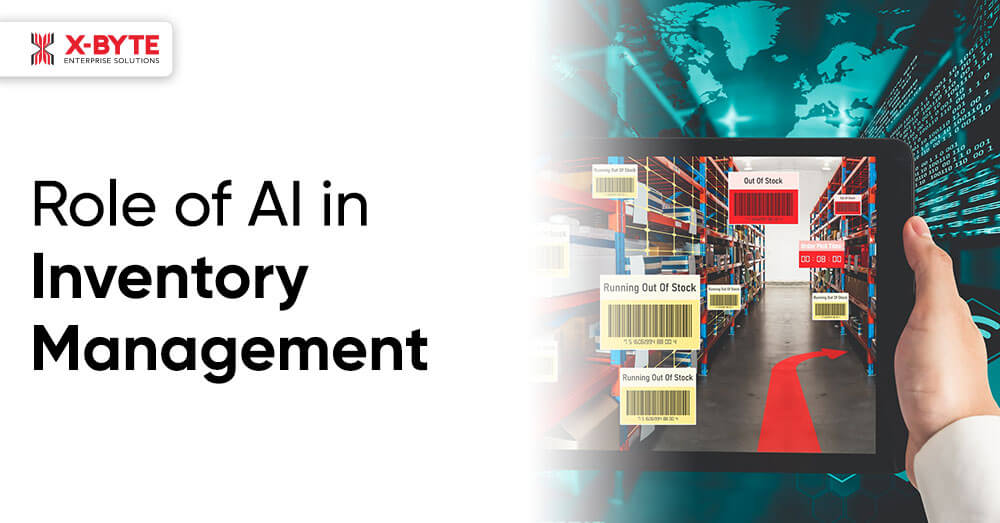
Inventory management, or inventory control, influences the strategies, activities, and processes to oversee stock and goods flow within a company. Poor stock control can lead to lost sales and smaller profits. So, using AI to handle stock can boost how well, fast, and businesses manage their goods. Businesses use many popular inventory management theories like Lean inventory management, Economic Order Quantity, ABC analysis (Pareto Principle), Six Sigma, Timwood, Kaizen, etc. AI supports managing inventory as per these frameworks and theories.
From classifying inventory and various product variants into logical groups and categories to demand forecasting for optimal stock levels throughout the business seasons, AI has capabilities to 5X ease your inventory management workflows. AI coupled with ML/Blockchain is a giant leap over traditional or manual inventory management methods. It also turbocharges automation with analytics that command automation tools to make accurate inventory-related decisions. AI in inventory management can bring unprecedented precision, speed, and efficiency in managing inventory.
Join us on this insightful journey as we uncover the transformative potential of AI in supporting diverse inventory management models.
Types of Inventory AI can Manage
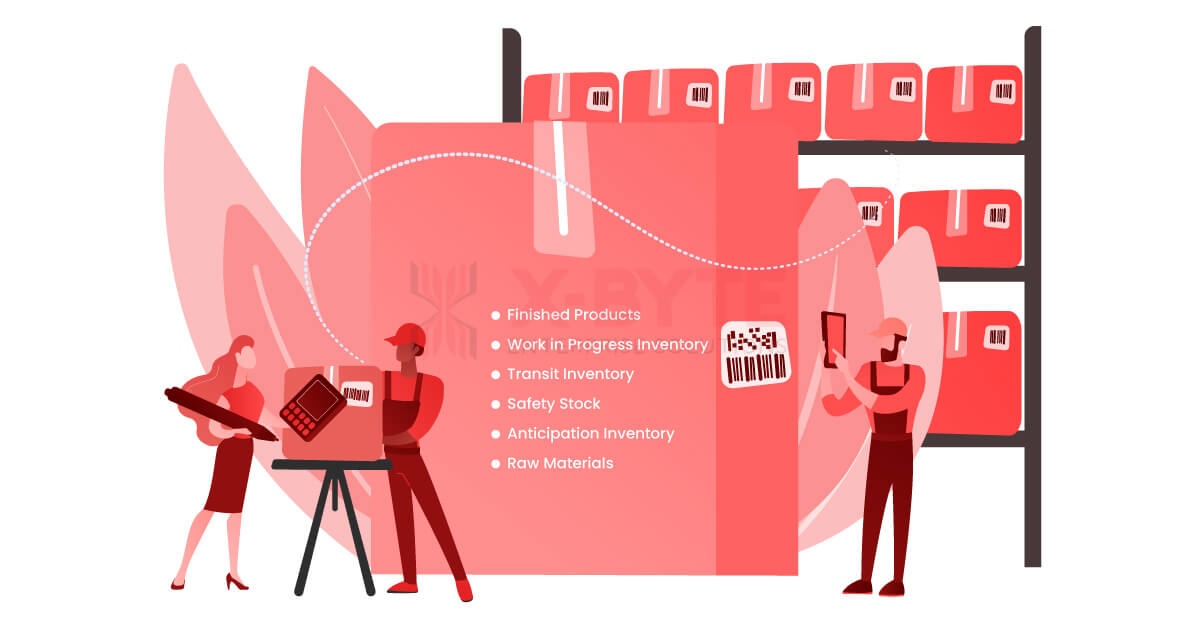
In the field of inventory management, different types of inventory need careful oversight. AI can manage the below types of inventory:
Finished Products
Work-In-Progress Inventory
Transit Inventory
Safety Stock
Anticipation Inventory
MRO Inventory
Raw Materials
Key Roles AI Plays in Inventory Management
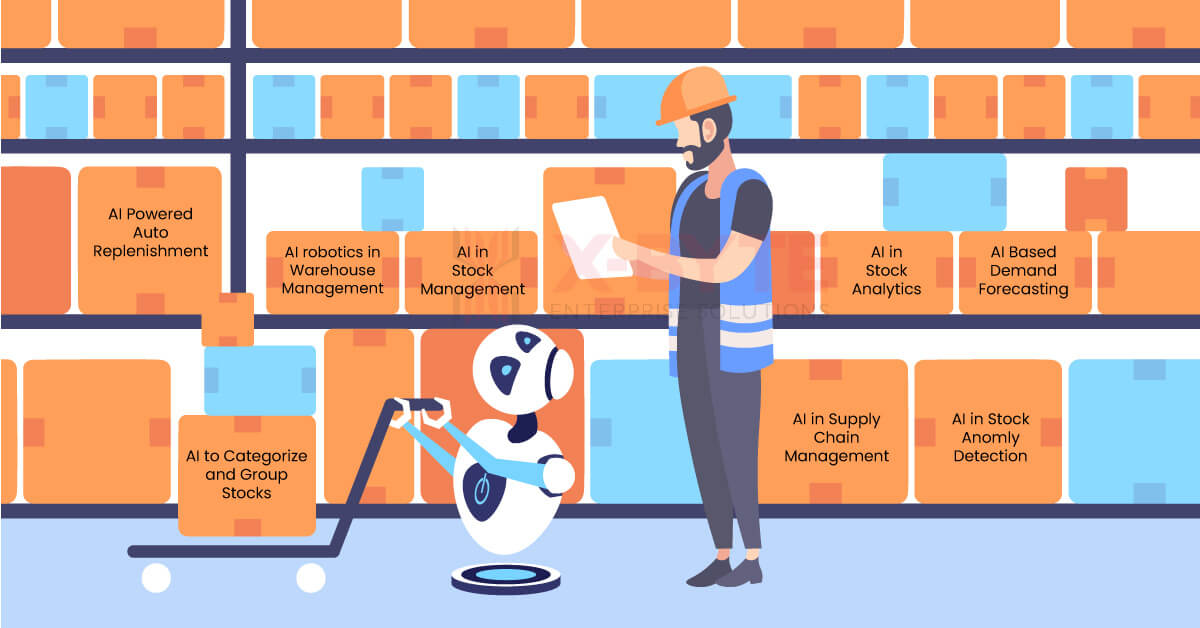
AI Robotics in Warehouse Management
AI robotics in warehouse management is another way to use artificial intelligence tech to manage inventory. Big warehouses with large-scale inventory operations now use robots with AI abilities. These warehouse robots differ from human workers because they don’t get tired and often work with high accuracy. AI robots can make warehouse layouts better, and find the most productive picking times, routes, and gear. For example, these robots can figure out if a certain weight needs a pallet, a skid, or a crate.
Gartner, Inc. predicts that by 2027, 50% of the businesses operating warehouses will adopt AI-powered vision systems to substitute conventional scanning methods used in cycle-counting processes.
A great example of AI robotics in warehouse management is the use of Autonomous Mobile Robots (AMRs) in e-commerce fulfillment centers. Unlike traditional Automated Guided Vehicles (AGVs) that follow set paths, AMRs use cutting-edge sensors and AI to move around the warehouse. AMRs can adjust to movement obstacles and change routes on the fly during busy times. AI robots stand out in speed, precision, and reliability in jobs like picking, packing, and sorting. AI also makes sure that workers pick the right items for shipment from the warehouse. Yet human workers still have a key part to play in more complex decision-making, problem-solving, and tasks that need fine motor skills or people skills.
Partner with X-Byte to integrate AI into your inventory management system and achieve unparalleled efficiency and accuracy!
AI in Stock Management
AI in stock management has a significant impact on efficiency, accuracy, and prediction. It excels in implementing and managing inventory methods like Lean inventory management, FIFO (First-In-First-Out), and LIFO (Last-In-First-Out) more than manual systems. AI-based inventory management systems can alert you about top-selling or slow-moving goods and boost stocking.
Together with machine learning algorithms and big data analytics, AI inventory systems can process and analyze past sales data, market trends, seasonal changes, and even outside factors such as weather patterns or economic indicators to figure out the best stock levels for both outlets and warehouses. This cutting-edge tech cuts carrying costs or eliminates situations like stockouts or extra stocks.
AI systems can also perform complex ABC analysis on their own sorting inventory items based on how important and valuable they are to the business. This lets inventory managers group high-priority items and make sure they’re stocked well enough.
A real-world example of how AI changes stock management is Amazon’s use of AI-powered robots in its warehouses. The company uses a system called “chaotic storage,” where it stores items randomly instead of in fixed spots. AI algorithms figure out the best storage spots based on things like item size how much people want it, and how often it ships. This system has allowed Amazon to store 50% more inventory in the same space compared to regular warehouses.
Human employees bring useful know-how and intuition to managing inventory, but they can handle so much information and make choices at a certain pace. AI tools can look at millions of data bits in no time spotting trends and making predictions that will be difficult for humans.
This means better predictions about what customers will want fewer mistakes when counting stock and putting in data, and the ability to act fast when market situations shift.
AI in Stock Analytics
AI-powered inventory management systems can analyze huge amounts of historical and real-time data to spot patterns, trends, and unusual occurrences that human analysts might overlook. These systems gather data from various sources, touchpoints, and contact points and examine them to offer inventory managers up-to-the-minute analytics about their stocks. The key stock analytics reports that AI can provide include reports on carrying costs, loss quantity, stock aging, suppliers, expiry, stock adjustments, stock movement, and transfers as well as stockout alerts, threshold limits, and many others.
A real-world example of AI in stock analytics is evident in Walmart’s rollout of an AI-driven inventory management system that links its 4,700 stores. The retail giant uses AI to predict inventory needs. This AI takes into account local events, weather forecasts, and even social media trends. In one case, the AI system forecasted a spike in demand for Pop-Tarts before a hurricane. It based this prediction on past data from similar events. Walmart found out that sales of Strawberry Pop-Tarts increased sevenfold before a hurricane. The company then used data mining to spot this trend. Walmart began strategically positioning Strawberry Pop-Tarts near the checkouts in advance of a hurricane.
AI to Categorize and Group Stocks
The AI-based stock categorizing has a big plus: it can handle tricky product lists and product variants. For items that are almost the same, AI can spot and group together products with small changes in size, color, or other features. This makes sure related items stay linked. AI tools can also sort products on their own using things like product details, pictures, and past data.
This hands-off method cuts down on the time and work needed for manual sorting while making things more accurate and consistent across big product lists. AI-powered tools can find and group like items, spot product versions, and build layered category structures. These structures make it easier to browse and search, both for in-house tasks and customer-facing screens.
- Brand-wise categorization becomes more productive as AI can spot brand names and logos from product pictures or details even when handling new or less popular brands.
- Size-wise categorization gains from AI’s ability to standardize and normalize size data across different measurement systems and product types.
- Product-wise categories can be made and kept up more, as AI systems can grasp the core features of products and group them based on function, use, or other key criteria.
McKinsey article reports that a major distributor in the electronics sector is employing generative AI-based LLM models to expedite the classification of tariff codes for their products. This shows the use of generative AI in inventory management.
AI in Supply Chain Management
New reports show Procter & Gamble now uses AI to make its supply chain work better. The AI system brings together complex information from five P&G areas: making products, moving products selling products, checking quality, and lab testing. This AI helps companies deal with big supply chain problems, like issues caused by unexpected events such as hurricanes or blocked canals.
AI positively impacts supply chain management by improving overall visibility and allowing for quick decisions. AI tools keep track of and examine data from different points in the supply chain giving a complete picture of how things are running and spotting possible problems before they happen.
This forward-thinking approach lets companies react fast to market shifts, keep the right amount of stock, and make customers happier by delivering on time and avoiding empty shelves. AI systems also watch and assess how well suppliers are doing helping businesses make smart choices about their relationships with suppliers and how to handle risks.
Benjamin Dollar, the Ben is a principal in the Global Supply Chain practice of Deloitte Consulting LLP says- “AI and machine learning, by their nature, can take enormous amounts of information, identify patterns, and enable rapid decision-making—much more rapid than natural intelligence would allow—which enables us to take action before a disruptive event in the supply chain occurs.”
Learn how X-Byte can help your business integrate AI solutions for superior stock control and competitive advantage.
AI in Stock Anomaly Detection (Theft, Lost Quantity Spoilage)
AI has caused a revolution in inventory management in spotting anomalies and oddities, theft detection, and finding spoiled goods. Smart tracking systems can keep an eye on stock with amazing precision. It’s like having a watchful guard in a huge warehouse, able to catch even tiny differences or weird patterns right away.
This is what AI does for managing inventory. It crunches tons of data to find deviations in patterns that might show theft, spoilage, or other stock problems. When something doesn’t fit the usual pattern, it sets off an alarm. For example, if stock levels drop and don’t match up with sales figures, the system can flag this as possible theft.
When it comes to spotting spoilage, systems powered by AI can work with IoT sensors to keep an eye on things like temperature and humidity.
Let’s look at a real example from the cosmetic industry. A company uses IoT sensors to watch the temperature and humidity in its warehouses. This info goes into an AI system that does two things: it tweaks storage conditions to keep them just right, and it also guesses when things might go bad based on changes in the environment and details about each product.
This forward-thinking approach helps stop losses from inventory going bad.
The blend of AI with IoT and blockchain tech makes it easier to spot and stop inventory problems. Take a luxury goods store as an example. They might mix these tools to prevent theft and check if items are real. RFID tags (IoT) on each product give live tracking info. AI systems look at this data to find odd movements that could mean theft.
At the same time, blockchain makes a record of each item’s trip through the supply chain that can’t be altered. This makes it hard for fake luxury goods to sneak into the stock without anyone noticing.
AI-based Demand Forecasting
AI has a significant impact on inventory demand analysis. It uses external data sources and advanced machine learning methods to make accurate predictions about short-term and long-term demand. This ability helps businesses adjust their stock levels ahead of time, lowering the chances of having too much or too little inventory.
In procurement, AI-powered inventory control software can improve buying decisions. These systems consider things like delivery times, supplier performance, and price chan
Forbes article reveals an interesting use case of AI for demand forecasting. Supply chain managers must forecast product demand to create effective ordering strategies. Typically, this involves analyzing historical sales data. However, for new products lacking sales records, this approach isn’t feasible. In these situations, AI software can help by using demand predictions from similar products and adjusting them as new sales information becomes available.
AI-powered Auto Replenishment
AI has caused a revolution in inventory management in auto-replenishment automated reorders, product-to-supplier mapping, and low inventory alerts. These AI-driven systems work like a super-efficient tireless inventory manager that doesn’t sleep always keeping an eye on stock levels and making real-time decisions.
AI-powered inventory auto-replenishment systems look at past sales data seasonal patterns, and even outside factors like weather or upcoming events to guess future demand. When the system thinks the stock is getting low, it orders more. This helps businesses keep just the right amount of stock without anyone having to check it themselves.
Automated reorders go beyond just starting the order. They also figure out the best amount to order and when to do it. The AI looks at how long it takes procure stocks. It’s like having a chess expert planning many steps ahead, always ensuring you have the right amount of stock when needed.
Auto product-to-supplier matching is another area where AI does a great job. By looking at things like price, quality how fast things get delivered, and how reliable suppliers are, AI can match products to the best suppliers on its own. This system keeps learning and changing switching suppliers as per their performances.
Automatic Threshold Detection and warning for low stock serve as an early alert system. The system sends alerts when stock volumes crosses these threshold limits. However, AI enhances this system. Rather than using fixed preset limits, AI systems can tweak these based on current demand trends, supply chain issues, or other key factors. When stock nears these threshold limits, the system sends out warnings enabling proactive management.
Transform your business operations with AI-powered Inventory management platforms and stay ahead of the curve!
Wrapping Up
AI integration in inventory management helps businesses get more precise and efficient stock control. Through AI robotics and advanced analytics, companies can make warehouse operations better. AI’s predictive analytics and real-time monitoring help businesses foresee demand changes and tweak inventory levels. This blend leads to lower holding costs, better service, and improved operations giving companies an edge in the market.
As AI grows, it will have an even bigger impact on inventory management.
If you are looking to integrate AI into your current inventory management systems or develop an AI-based inventory management software from scratch, contact X-Byte. We are a leading inventory management software development company with resources, an expert team, and experience in providing AI inventory solutions for various industries and business verticals.